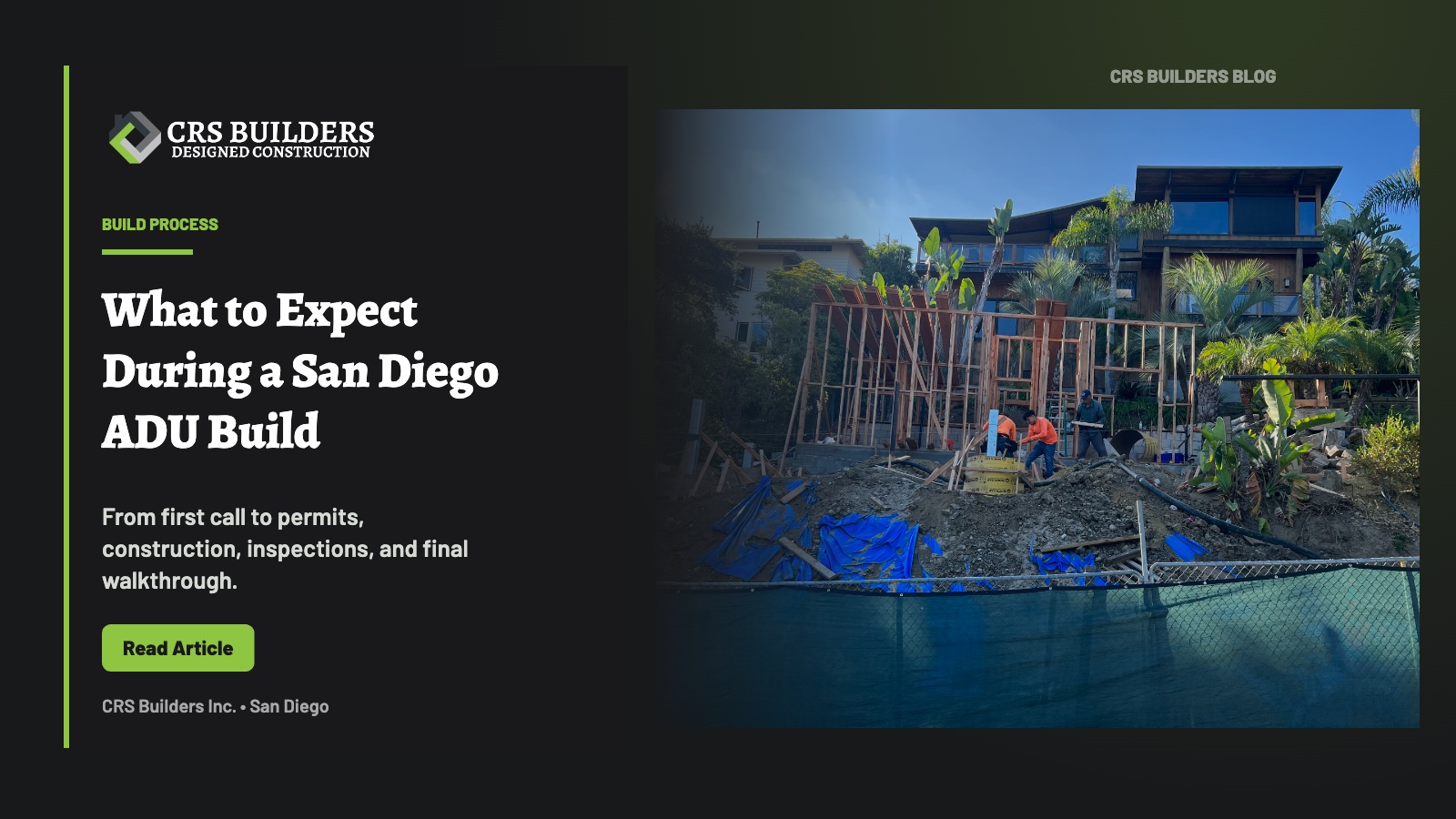
Building an ADU is exciting, but it can also feel intimidating if you have never been through a construction project before. Homeowners usually have the same questions: How does the process start? When do plans happen? What does permitting involve? How disruptive is construction? What decisions do we need to make? How do we avoid surprises?
A good builder should be able to explain the process clearly before work begins.
This guide walks through what to expect during a San Diego ADU build process, from the first conversation to final inspection. The exact timeline and scope will vary by property, but the overall path is similar: goals, feasibility, design, permits, preconstruction, construction, inspections, and turnover.
Step 1: The First Conversation
The first call is not just about square footage. It is about understanding why you want to build.
CRS Builders Inc. will want to understand:
- What you want the ADU to do
- Who will use the space
- Whether rental income is part of the plan
- Whether you are considering a detached ADU, garage conversion, or JADU
- Where the unit might go
- Your ideal timeline
- Any known site constraints
- Your expectations around quality and investment
This first conversation helps determine whether the project is likely to be a good fit and what information is needed next.
Step 2: Property Feasibility Review
Before a design is finalized, the property needs to be evaluated. ADU feasibility is one of the most important phases because it helps prevent bad assumptions.
A feasibility review may consider:
- Lot size and layout
- Setbacks
- Buildable area
- Existing structures
- Garage condition, if relevant
- Construction access
- Slope and drainage
- Utility locations
- Electrical capacity
- Sewer and water access
- Fire-zone conditions
- Coastal Overlay Zone considerations
- Privacy from the main home and neighbors
This is where the project may become more specific. A homeowner may start with a detached ADU idea, but a garage conversion or JADU may fit the property better. Another homeowner may assume the garage is the best option, but a detached ADU may provide better long-term function.
Step 3: Scope Alignment
Scope alignment means matching the homeowner’s goals to the property, design direction, and investment level.
This is where CRS Builders Inc. helps clarify what kind of project is actually being discussed. A compact JADU, a garage conversion, a custom detached ADU, and an attached ADU are not the same scope. They have different design requirements, construction needs, permit considerations, and finish expectations.
A quality builder should help you understand:
- What is included in the project
- What decisions affect complexity
- Which site conditions may affect construction
- Which finish level fits the goal
- What needs to be resolved before permitting
- What could create change orders if ignored early
CRS currently builds in a quality-focused context where project scope can land around $400–$750 per square foot, depending on site conditions, finishes, utility work, structural complexity, and project type. The goal of scope alignment is not to chase the lowest number. It is to make sure the plan, expectations, and investment level match before construction begins.
Step 4: Design Direction and Layout
Once feasibility and scope are understood, design can move forward with more confidence.
Design decisions include:
- ADU placement
- Entry location
- Bedroom count
- Kitchen layout
- Bathroom layout
- Storage
- Laundry
- Window placement
- Outdoor space
- Privacy strategy
- Exterior style
- Finish direction
This is the phase where the ADU starts to become real. But the best designs are still grounded in practical constraints: utilities, structure, access, setbacks, drainage, and budget.
A beautiful design that ignores construction reality is not helpful. A strong ADU design balances livability, code, buildability, and long-term value.
Step 5: Plans, Engineering, and Documentation
After the layout direction is established, the project moves into construction documents and technical coordination.
Depending on the project, this may involve:
- Site plan
- Floor plans
- Elevations
- Roof plans
- Structural drawings
- Engineering calculations
- Title 24 energy documentation
- Electrical plans
- Plumbing plans
- Mechanical plans
- Stormwater forms
- City-required forms
San Diego requires Building Permits for ADUs and JADUs. If the property has special conditions such as coastal overlay, fire hazard, slope, or brush management considerations, documentation may require additional care.
This phase is not always glamorous, but it is essential. Good documentation helps the project move through permitting and gives the construction team a clearer path.
Step 6: Permit Submittal and City Review
Once the documents are ready, the project is submitted for permit review.
The City review process may involve comments, corrections, or requests for clarification. That is normal. The important thing is having a team that can respond clearly and keep the project moving.
Permit timing can vary based on:
- Project complexity
- Completeness of the application
- City workload
- Site-specific conditions
- Coastal or fire-related review
- Revisions requested by reviewers
CRS Builders Inc. helps homeowners understand that permitting is part of the project timeline. It should be planned for, not treated as a surprise.
Step 7: Preconstruction Planning
After permit approval, the project moves into preconstruction. This is the bridge between paperwork and building.
Preconstruction may include:
- Final scope review
- Schedule planning
- Material and finish coordination
- Site access planning
- Protection of existing property
- Utility coordination
- Subcontractor scheduling
- Confirming owner decisions
- Preparing for demolition or site work
This phase helps reduce confusion once crews are on site. The more decisions are clarified before construction starts, the smoother the build can be.
Step 8: Site Preparation
Construction begins with preparing the area.
Site preparation may include:
- Clearing or demolition
- Protecting existing hardscape or landscaping
- Establishing access paths
- Temporary fencing or safety measures
- Utility locating
- Excavation or trenching
- Drainage preparation
- Foundation layout
For garage conversions, site preparation may involve selective demolition, removing the garage door, opening walls, evaluating the slab, and preparing for new utilities or framing.
For detached ADUs, site preparation may involve grading, foundation prep, utility trenching, and material staging.
Step 9: Foundation, Framing, and Structural Work
For a detached ADU or addition, the foundation and framing phases are where the project visibly takes shape.
This phase may include:
- Foundation forms and pour
- Slab or raised foundation work
- Wall framing
- Roof framing
- Structural hardware
- Sheathing
- Weatherproofing
- Window and door openings
For garage conversions and JADUs, structural work may be different. Instead of a new foundation and full frame, the work may involve modifying existing framing, infilling openings, reinforcing walls, or creating new entries.
This is one reason project type matters. Different ADU paths have very different construction realities.
Step 10: Rough Plumbing, Electrical, and Mechanical
After framing, the major systems are installed.
Rough-in work may include:
- Plumbing supply lines
- Drain and waste lines
- Electrical wiring
- Lighting locations
- Appliance circuits
- HVAC lines or equipment
- Bathroom ventilation
- Kitchen ventilation
- Fire or safety-related assemblies
This phase is where good planning pays off. If the kitchen, bathroom, laundry, and mechanical systems were coordinated early, rough-in work is more straightforward.
Step 11: Insulation, Drywall, and Interior Buildout
Once rough systems pass required inspections, the ADU starts to feel like an interior space.
This phase includes:
- Insulation
- Drywall
- Texture or finish prep
- Interior doors
- Cabinetry
- Tile
- Flooring
- Painting
- Trim
- Fixtures
- Appliances
- Lighting
- Finish plumbing and electrical
For homeowners, this is often the most exciting part because the design choices become visible. It is also where durability matters. ADUs are small spaces that get daily use, so finishes should be selected for both appearance and longevity.
Step 12: Exterior Work and Site Finish
Exterior work may happen throughout the project, but final site finish brings everything together.
This can include:
- Stucco or siding
- Roofing completion
- Exterior paint
- Gutters or drainage components
- Concrete paths or patios
- Exterior lighting
- Fencing
- Landscape touchups
- Privacy screening
- Final cleanup
The exterior should make the ADU feel integrated with the property. A well-built ADU should not look like a temporary unit dropped into the backyard. It should feel intentional.
Step 13: Inspections and Final Walkthrough
Throughout construction, inspections confirm that work is being completed according to approved plans and applicable codes.
Final steps may include:
- Final building inspection
- Final electrical/plumbing/mechanical inspection as applicable
- Punch list review
- Owner walkthrough
- Finish adjustments
- Cleanup
- Turnover
The final walkthrough is the homeowner’s opportunity to understand the completed space, review details, and confirm remaining punch-list items if any.
How Homeowners Can Help the Process Go Smoothly
A good builder manages the project, but homeowners also play an important role.
You can help by:
- Being clear about your goals early
- Sharing known property information
- Making selections on time
- Asking questions before construction starts
- Being realistic about permitting timelines
- Understanding that site conditions can matter
- Avoiding major scope changes mid-build
- Staying responsive during key decision points
The smoother the communication, the better the experience.
Common ADU Process Mistakes to Avoid
Starting With a Plan Before Feasibility
A floor plan is only useful if it fits the property. Feasibility should come first.
Underestimating Permitting
Permitting is not a side task. It is a real phase of the project and should be included in the timeline.
Making Finish Decisions Too Late
Late selections can slow ordering and scheduling. Decide key finishes before they become urgent.
Ignoring Utility Complexity
Electrical, sewer, water, and HVAC decisions affect design and construction. They should be evaluated early.
Choosing Based Only on Price
The lowest number does not always produce the best project. Scope, quality, communication, and experience matter.
Frequently Asked Questions About the San Diego ADU Build Process
How long does it take to build an ADU in San Diego?
The full timeline depends on design, permitting, site conditions, project type, and construction scope. Homeowners should think in phases: feasibility, design, permit review, preconstruction, construction, inspections, and turnover.
What happens first when I contact CRS Builders Inc.?
The first step is a conversation about your goals, property, desired use, timeline, and project type. From there, CRS can help determine whether feasibility review, design planning, or another next step makes sense.
Do I need plans before calling a builder?
No. In many cases, it is better to speak with a builder before investing heavily in plans. A feasibility review can help make sure the design direction fits the property and construction reality.
What causes ADU delays?
Common delays include incomplete plans, permit comments, late selections, utility surprises, site access issues, scope changes, and special conditions such as coastal or fire-zone requirements.
Can CRS Builders handle garage conversions and JADUs too?
Yes. CRS Builders Inc. works on ADUs, JADUs, garage conversions, home additions, and new custom homes. The best path depends on the property and goals.
How should I budget for a quality ADU?
Budget should be based on scope, site conditions, design, utilities, structural needs, finish level, and permitting requirements. CRS currently builds in a quality-focused context where project scope can fall around $400–$750 per square foot depending on the details.
Ready to Understand the ADU Process for Your Property?
A successful ADU is not just a finished structure. It is the result of good planning, clear scope, strong communication, quality construction, and a process that respects the property.
Thinking about building an ADU in San Diego? Call CRS Builders Inc. at 858-788-3839 or visit crsbuildersinc.com to schedule a consultation.
CRS Builders Inc. helps San Diego homeowners plan and build ADUs, JADUs, garage conversions, additions, and new custom homes.