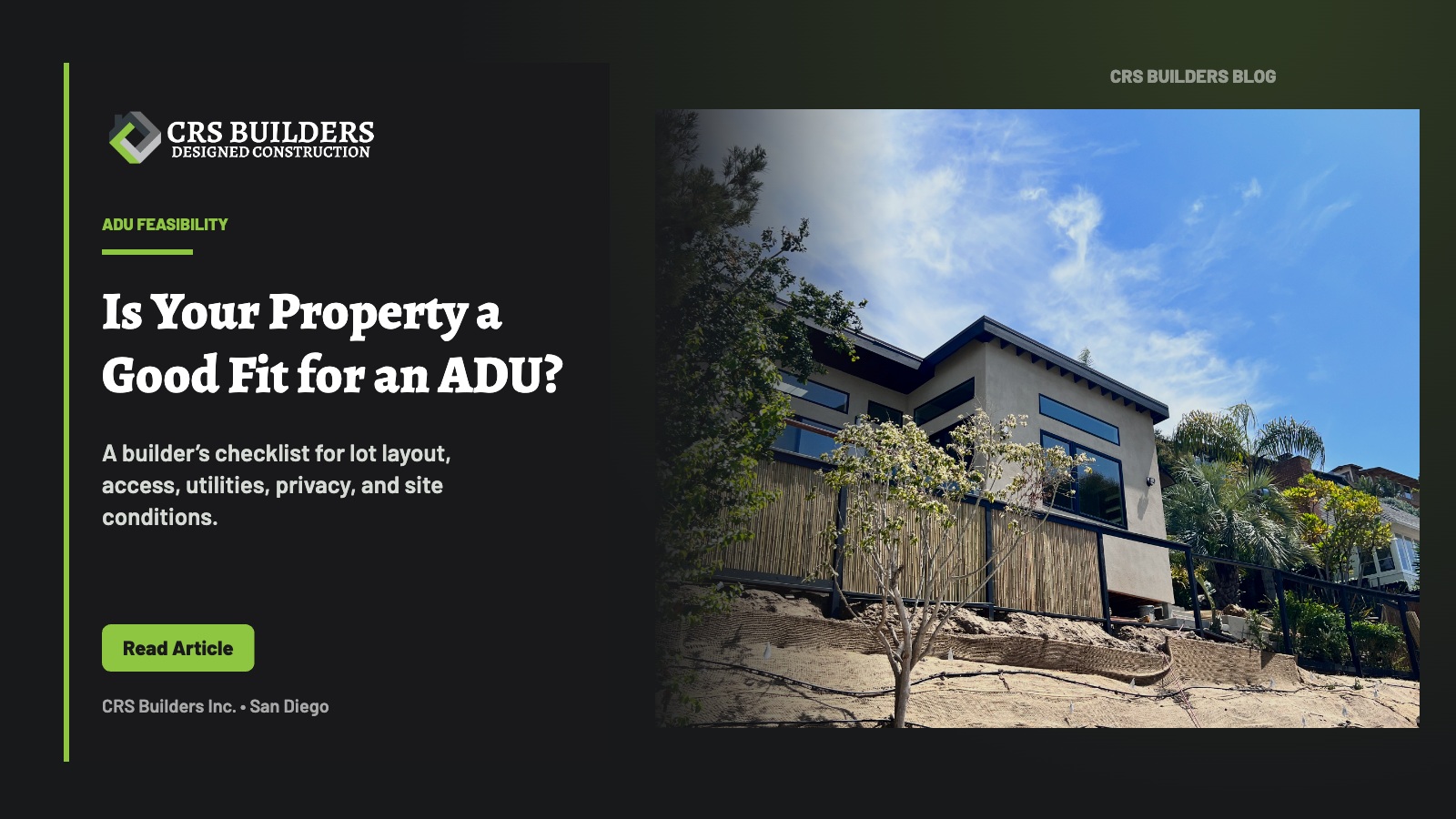
Reading about ADU permits is helpful. Seeing how another homeowner used an ADU for rental income is motivating. But before you choose a floor plan or start picturing finishes, there is one question that matters most: is your San Diego property actually a good fit for an ADU?
That is where ADU feasibility comes in.
A strong ADU project starts with the property. The shape of the lot, the location of the main house, the slope of the yard, utility access, privacy, fire-zone conditions, and construction access can all influence what is realistic. Two homeowners may both have “room in the backyard,” but one property may support a straightforward detached ADU while another may be better suited for a garage conversion, JADU, or home addition.
This builder’s checklist will help you understand what CRS Builders Inc. looks at during an early ADU feasibility review in San Diego.
Why Feasibility Comes Before Design
Most homeowners want to start with inspiration photos. That is understandable. A beautiful detached ADU, a polished garage conversion, or a compact guest suite makes the project feel real.
But design should follow feasibility, not the other way around.
If you design first and evaluate later, you risk falling in love with a plan that does not fit your property, budget, permit path, or long-term use. A feasibility-first approach helps answer practical questions early:
- Where can the ADU actually go?
- Can crews access the build area?
- How will the ADU connect to utilities?
- Will privacy be comfortable for the main home and the ADU?
- Are there fire, coastal, slope, or drainage issues?
- Is a detached ADU the right answer, or would another project type be smarter?
A good feasibility review does not kill creativity. It gives the design a stronger foundation.
1. Lot Layout and Buildable Area
The first step is understanding the property layout. A San Diego ADU needs more than open space. It needs usable, buildable space.
A builder will look at:
- Lot size and shape
- Location of the existing house
- Side yard and rear yard conditions
- Front yard conditions
- Existing patios, pools, walls, sheds, and landscaping
- Easements or access limitations
- Space for outdoor circulation
- Separation between the main home and the new unit
A rectangular flat lot may be easier to evaluate than a hillside, canyon-adjacent, or irregularly shaped property. But “easy” is not always the goal. Some of the best ADU opportunities come from lots that require a thoughtful layout.
The key is matching the design to the property instead of forcing the property to accept a generic plan.
2. Setbacks and Property Lines
Setbacks are the required distances between a structure and the property lines or other regulated areas. San Diego ADU rules can be favorable, but setbacks still need to be evaluated carefully.
Detached ADUs and additions may have different implications depending on location, height, existing structures, fire separation, and building code requirements. Even where an ADU may be allowed near a property line, building code issues such as fire separation, wall openings, and allowable height can affect the final design.
This is one reason a site-specific review matters. Looking at a zoning summary online is not the same as confirming how the ADU will sit on the actual property.
3. Construction Access
Homeowners often think about how the finished ADU will look, but builders also have to think about how the ADU will be built.
Construction access affects logistics, schedule, and complexity. CRS Builders Inc. will look at questions like:
- Can materials be brought into the backyard easily?
- Is there side-yard access?
- Is the access path narrow or obstructed?
- Are there stairs, retaining walls, or grade changes?
- Can equipment reach the work area?
- Where can materials be staged?
- How will crews protect the existing home and landscaping?
A tight urban lot can still support an ADU, but access may influence the construction plan. The earlier this is understood, the better.
4. Utility Access: Sewer, Water, Electrical, and HVAC
Utilities are one of the biggest feasibility factors for ADUs. A legal, comfortable ADU needs real systems: plumbing, electrical, heating and cooling, ventilation, and often upgraded infrastructure.
A feasibility review should identify:
- Where the sewer line is located
- How water will connect
- Whether trenching is needed
- Existing electrical panel capacity
- Whether a subpanel or service upgrade may be needed
- HVAC strategy
- Hot water strategy
- Gas vs all-electric planning
- Solar implications for newly constructed detached ADUs
Utility access can heavily shape the design. For example, placing the ADU bathroom and kitchen closer to existing plumbing may reduce complexity. On another property, privacy or layout may justify a longer utility run.
The point is not to avoid complexity at all costs. The point is to understand it before the design is finalized.
5. Fire Zone and Brush Management Conditions
Some San Diego properties are located in High or Very High Fire Hazard Severity Zones or near brush management areas. These conditions can affect setbacks, materials, defensible space, access, and review requirements.
City guidance allows fire officials to require greater setbacks or additional measures when needed for code compliance and safety. For homeowners, this means fire conditions should be evaluated early.
If your property is near a canyon, open space, hillside, or brush area, do not assume the ADU process will be the same as a flat inland lot. A quality builder will account for fire-related design and construction considerations from the beginning.
6. Coastal Overlay Zone Considerations
Properties in or near San Diego’s Coastal Overlay Zone may have additional rules. Coastal review can affect ADUs and JADUs depending on whether the project is contained within the existing primary structure, increases habitable area, converts non-habitable space, or involves other coastal considerations.
This does not mean an ADU is impossible. It means the path needs to be understood.
If you are in La Jolla, Pacific Beach, Point Loma, Mission Beach, Ocean Beach, Del Mar, Encinitas, Carlsbad, or another coastal community, confirm the coastal implications before getting too attached to a design.
7. Slope, Drainage, and Retaining Walls
San Diego lots are not always flat. Slope can create both opportunities and complications.
A sloped property may offer better views, more privacy, or a natural lower-level ADU opportunity. It may also require additional planning for:
- Grading
- Drainage
- Retaining walls
- Foundation design
- Stairs or pathways
- Stormwater management
- Construction access
Drainage is especially important. A new ADU should not create water problems for the main home, the ADU, or neighboring properties. Site planning should address how water moves across the property before construction begins.
8. Privacy Between the ADU, Main Home, and Neighbors
A technically buildable ADU is not automatically a livable ADU. Privacy matters.
CRS Builders Inc. evaluates how the new unit will feel on the property. Important questions include:
- Will the ADU entry feel private?
- Will windows look directly into the main home?
- Can landscaping or fencing improve separation?
- Is there room for a small patio or outdoor area?
- Will the ADU affect neighbor privacy?
- Can the main home keep its own outdoor living space?
Privacy is especially important if the ADU will be used as a long-term rental, parent suite, or adult-child living space. Good planning can make the ADU feel independent without making the property feel divided.
9. Existing Garages and Accessory Structures
Sometimes the best ADU opportunity is not in the open yard. It may be an existing garage or accessory structure.
A garage conversion can be a strong option when:
- The garage is structurally sound
- The location offers privacy
- Utilities are accessible
- The garage dimensions support a functional layout
- The homeowner wants to preserve yard space
But a garage conversion is not automatically simple. A garage was not built as living space. It may need insulation, windows, plumbing, electrical upgrades, HVAC, fire separation, moisture control, and a complete interior redesign.
During feasibility, CRS Builders can help compare whether a garage conversion, detached ADU, JADU, or addition makes the most sense.
10. Matching the ADU Type to the Property
Once the site conditions are understood, the next question is project type.
A property may support several options:
| Property Condition | Possible Best Fit |
|---|---|
| Large backyard with good access | Detached ADU |
| Underused attached garage | Garage conversion or JADU |
| Tight lot but flexible home layout | JADU or attached ADU |
| Need more space for the main household | Home addition |
| Poor existing structure but strong lot | New custom home or major rebuild conversation |
| Privacy is the top priority | Detached ADU with thoughtful placement |
| Yard preservation is the top priority | Garage conversion or interior JADU |
The right answer depends on the homeowner’s goal. Rental income, family housing, caregiving, guest space, and long-term flexibility all point to slightly different solutions.
11. Budget Reality Without Lowballing the Project
Feasibility is not just about whether an ADU can be built. It is also about whether the project scope aligns with the investment level.
CRS Builders Inc. is not a bargain-volume ADU shop. Quality construction in San Diego depends on site conditions, design, structural work, utilities, finishes, access, and permitting requirements. Current CRS build context can fall around $400–$750 per square foot, depending on the project and scope.
That does not mean every feasibility conversation starts with a fixed number. It means the builder and homeowner should be honest early about the level of construction being considered. A well-built ADU, garage conversion, or JADU should be planned as a long-term improvement to the property, not a temporary backyard structure.
12. When a Site Visit Changes the Plan
It is common for homeowners to start with one idea and end up with a better one after a site review.
Examples:
- A homeowner wants a detached ADU, but a garage conversion preserves the yard and improves access.
- A homeowner wants a garage conversion, but the garage condition makes a new detached ADU more sensible.
- A homeowner wants a JADU, but privacy and bathroom access point toward an attached ADU.
- A homeowner wants maximum rental potential, but the lot layout suggests a smaller, better-designed unit will function better.
This is not a failure of the original idea. It is the value of feasibility. A good builder helps you find the right path before you spend heavily on plans.
Frequently Asked Questions About ADU Feasibility in San Diego
Can I build an ADU on my San Diego property?
Many San Diego properties can support an ADU, but the right answer depends on zoning, lot layout, setbacks, utilities, access, fire or coastal conditions, and your project goals. A site-specific feasibility review is the best first step.
What makes a property a good ADU candidate?
A strong ADU candidate usually has usable buildable area, reasonable construction access, practical utility connections, privacy potential, and a layout that supports the intended use. Some complex lots can still work with the right design.
Do I need to know my setbacks before calling a builder?
No. You do not need to solve the zoning and setback questions before contacting CRS Builders Inc. A builder can help identify the constraints and explain how they affect your options.
Is a garage conversion easier than building a detached ADU?
Sometimes, but not always. A garage conversion uses an existing structure, but the garage may need substantial upgrades to become legal, comfortable living space. The condition of the garage and utility access matter.
What if my property is in a fire zone or coastal area?
An ADU may still be possible, but fire-zone and coastal conditions can affect setbacks, materials, review, access, and permitting. These issues should be evaluated early.
How much does ADU feasibility affect budget?
A lot. Site access, utilities, slope, drainage, fire requirements, structural work, and finish level all affect investment. CRS Builders Inc. currently builds in a quality-focused context where scope can land around $400–$750 per square foot depending on the project.
What should I prepare before an ADU consultation?
Helpful information includes your address, goals for the ADU, preferred use, rough timing, any known property constraints, and whether you are considering a detached ADU, garage conversion, JADU, or addition.
Ready to Find Out What Your Property Can Support?
The best ADU projects start with a clear understanding of the property. Before you commit to a plan, make sure the lot, utilities, access, privacy, and budget expectations all make sense.
Thinking about an ADU in San Diego? Call CRS Builders Inc. at 858-788-3839 or visit crsbuildersinc.com to schedule a property-specific consultation.
CRS Builders Inc. helps San Diego homeowners plan and build ADUs, JADUs, garage conversions, home additions, and new custom homes.